Revelation Movement

India

The Bible Created the ‘Steel Frame’ of India

by Vishal Mangalwadi, Samuel Davidson and Ishita Davidson Sardar Vallabhbhai Patel (1875–1955), India’s first Deputy Prime Minister and Home Minister, described the colonial Civil Services as “The Steel Frame of India.” Who or what built that frame?  The short answer is: the Bible.  Between 1765 and 1820, British rulers were as corrupt as today’s Indian civil servants. Most Indians feel that our criminal politicians use civil servants to loot our tax money and extract bribes from helpless citizens. Now they are also using the police to persecute political opponents and religious minorities. Why then did Patel, India’s “Iron Man,” describe colonial-era civil services as the “steel frame” of justice and fairness that held India together?  Vallabhbhai Patel, who fought against the British Raj, praised civil servants on 21 April 1947 at Metcalf House in Delhi. He argued that after independence, the Indian Civil Services (ICS), created by colonial rulers, should continue serving the new nation. Its name would change from ICS to IAS (Indian Administrative Services). Patel’s phrase “the steel frame” came from a 1922 speech by British Prime Minister David Lloyd George.  Management guru Peter Drucker described colonial civil services as a model of public administration and management. It was the reason, he asserted, that colonialism survived for two centuries. Many of its cadre were sons of British pastors. Their parents and churches prayed that these young men would serve India with diligence and integrity. Their prayers were answered.  Drucker does not defend colonialism. He knew that the British Raj was marked by muddled policies, indecision, misdirection, and failures.  It survived for as long as it did because the Bible-based Evangelical movement built the Indian Civil Services. The ICS, says Drucker, was Britain’s “supreme administrative accomplishment”:  [The Civil Servants] were younger sons of poor country parsons, with no prospects at home and little standing in English society.  Their pay was low, and such opportunities for loot or gain as their predecessors had enjoyed in the swashbuckling days of the East India Company a hundred years earlier had, by 1860, been completely eliminated by both law and custom. These untrained, not very bright, and totally inexperienced youngsters ran districts comparable in size and population to small European countries. And they ran them practically all by themselves with a minimum of direction and supervision from the top. Some, of course, became casualties and broke under the strain, falling victim to alcohol, to native women, or—the greatest danger of them all—to sloth. But most of them did what they were expected to do and did it reasonably well. They gave India, for the first time in its long and tragic history, peace, a measure of freedom from famine, and a little security of life, worship, and property. They administered justice impartially and, at least as far as they themselves were concerned, honestly and without corruption.  They collected taxes by and large, impartially and equitably. They did not make policy, and in the end, they foundered because they had none. But they administered, and administered well. (Peter Drucker. Management: Tasks, Responsibilities, Practices, pp. 403-404. Emphasis added.) Robert Clive, a clerk in the Madras office of the East India Company, laid the foundations of the British Raj in 1757 by defeating Bengal’s Nawab, Siraj-ud-Daulah. Clive supported the appointment of the new Nawab, Mir Qasim, who ruled until 1763. In 1762, Mir Qasim described British corruption in a letter to the Governor and his council. And this is the way your gentlemen behave; they make a disturbance all over my country, plunder the people, and injure and disgrace my servants… They forcibly take away the goods and commodities of the peasants, merchants, etc., for the fourth part of their value, and by way of violence and oppression, they oblige the peasants to give five rupees for goods which are worth but one rupee. (Philip Mason. The Men Who Ruled India. pp. 38-39) As mentioned earlier, seven decades later, one of Britain’s greatest historians, Lord Macaulay, confirmed Mir Qasim’s testimony regarding the corruption of British rulers. In his Essay on Clive, Macaulay wrote that the British East India Company was a “gang of public robbers” that “had spread terror through[out] the whole plain of Bengal.” Its governance was as “oppressive as the most oppressive form of barbarian despotism… strong with all the [military] strength of civilization. It resembled the government of evil Genii rather than the government of human tyrants.”  The British Parliament denounced Clive as a corrupt “Nabob.” He was followed by Governor-General Warren Hastings, who expanded British rule in India. Hastings, too, was tried for corruption. During his trial, Edmund Burke, the father of modern conservatism, put his finger on the root of a philosophical problem. Accusing the British East India Company, Burke said, “. . . these Gentlemen have formed a plan of Geographical morality, by which the duties of men in public and private situations are not to be governed by their relations to the Great Governor of the Universe or by their relations to men, but by climates, degrees of longitude and latitude…. As if, when you have crossed the equinoctial line, all the virtues die… as if there were a kind of baptism, like that practiced by seamen, by which they unbaptise themselves of all that they learned in Europe and commence a new order and system of things.”  Burke’s charge was that in India, a corrupt East India Company was practicing a ‘Geographical’ or relative morality that was not governed by God’s moral (absolute) laws. In his influential work, The Men Who Ruled India, Philip Mason points out that this moral relativism was justified to maintain British rule and trade in India. Trade interests overruled God’s moral law.  The Company presumed that “to be fair to Indians was to be prejudiced against the English.”  Burke’s accusation, confirmed by Charles Grant and others, inspired  British Evangelicals to reform the Company. Anglican Evangelicals were  just beginning to emerge out of the Wesleyan revival of the late eighteenth century. They were

The Bible Created the ‘Steel Frame’ of India Read More »

IDOLATRY, THE BIBLE & INDIA’S ECONOMIC FLOURISHING

Shah Jahan, the Mughal Emperor, brought Persian architects to build the Taj Mahal in Agra, on the bank of the river Yamuna. A century later (1837-1838), the monsoon failed and a severe famine devastated the Agra region. Over 800,000 people starved to death. The Mughals still ruled on the bank of the Yamuna, 150 miles north in Delhi. The Yamuna continued to flow down another 300 miles before merging with the Ganga in Allahabad, now renamed Prayagraj. Both the Yamuna and the Ganga come gushing down from the snow-clad Himalayas. So should ‘Doab,’ the land between the two rivers, lack water? Proby Thomas Cautley (1802-1871), a British military engineer, said, “NO.” He decided to change the future. Between 1842 and 1854, Cautley built the Ganga Canal System which now irrigates about 9,000 square miles of agricultural land. The mission to build the world’s largest canal system of that day came with many challenges: religious, political, financial, technical and educational. The Hindu priests objected to his “Christian” conspiracy to “imprison” the spirit of goddess Ganga by building a barrage that would re-direct its flow. They worshipped the life-giving river and built temples and ashrams along its banks. There, our people learned the rites of river worship. They were also taught meditation and tantric (sexual) techniques to empty their minds in order to experience inner bliss. India had plenty of leaders as capable as Cautley, but they used their abilities to organize festivals on the banks of “holy” rivers. No one ever built an institution to train engineers to establish human dominion over them. Our wealthy men financed grand temples; a vision of the Ganga Canal did not interest them. Cautley was an employee of the British East India Company which was created to trade and make money for its directors and shareholders. Investing in canals was not its mission. Therefore, Cautley had to turn to the British Parliament. Thankfully, in 1833, Parliament had already accepted Lord Macaulay’s case that Britain must rule over India to bless and prepare her for freedom. Macaulay’s childhood friend, Sir Charles Grant Jr., was the Company’s head and a Member of Parliament. His father, Charles Grant (Senior), had witnessed the horrors of the Bengal famine of 1770 and called to reform East India Company’s rule. In 1790, Grant Sr. teamed up with William Wilberforce and Lord Macaulay’s father, Zachary Macaulay, to change colonialism. In Divine Providence, 1837 marked the beginning of the Victorian Era—an age in which the moral fervor of the Evangelical movement influenced public policy as much as Capitalism’s economic interests. The Parliament’s support made it possible to finance the Ganga Canal. Cautley’s personal credibility undergirded his optimism. As the son of an Evangelical priest, Rev. Thomas Cautley, Proby was nurtured in the Bible. He was unashamed of his belief that human beings were created to rule over creation, not to worship rivers or idols. He rejected India’s pessimistic “Noble Truth” that “Life is suffering,” which implied that the only way to escape suffering was to escape life itself. To Cautley, the famine confirmed that the land and all of humanity were under a curse, brought on by sin. He believed the Gospel that God desires to forgive our sins and make us His sons. Forgiveness delivers us from the curse. He believed that God sent the Savior to bear our sin and its curse on Calvary’s cross. Salvation makes a tangible difference. Biblical optimism was already revolutionizing India. However, he did not impose his faith upon the people he wanted to serve. He appeased his religious opponents by building bathing ghats on the Ganga. This enabled Hindu priests to continue their profession of giving ritual baths to devotees even during the monsoon. Cautley needed not just money but also engineers to build the Ganga Canal. No Indian had ever built an institution to train engineers. Cautley’s dream to build an engineering college was supported by Lieutenant Governor James Thomason (1804-1853). After Independence, the governments of India upgraded James Thomason Engineering College to the status of an Engineering University and finally to the Indian Institute of Technology (IIT), Roorkee. The college taught more than science and practical skills. It also imparted an optimistic worldview, ethical values, work ethic and a cooperative spirit that are necessary for building lasting projects and flourishing nations. Where would they find students qualified to enroll in an engineering college that fights hunger and famines? That challenge inspired James Thomason to do what no Hindu, Buddhist, Muslim or Sikh ruler had done in North India. He established 857 schools throughout that region. During the last few years, the militant Hindu government has closed down more than 20,000 public schools in UP. This educational movement was the fruit of a new worldview that the Bible brought to India. It believed that the true wealth of a nation lies buried in the hearts and minds of its people and that education brings out that inner wealth. Hunters/gatherers toil day and night, but whether their labor will produce wealth depends on many factors. The key question is: how much mind, skill, planning, as well as the community’s trust and cooperation, is invested in that work. Economic flourishing depends on the Intellectual and moral development of the people. Education enables them to harness God-given resources such as water, land, sunlight and petroleum. Colonialism had no need to invest in educating Indian masses. James Thomason, the governor, promoted education because he had studied the Bible under his father, Rev. Thomas Truebody Thomason (1774-1829). Rev. Thomason came to Bengal in 1808, set up the first Church Missionary Society schools in Bengal, founded a Schoolbook Society and a Female Orphan Society for the illegitimate children of Europeans. He helped establish Calcutta’s Bible Society and translated the Old Testament into Hindustani. Before coming to Bengal and serving as a Chaplain to the East India Company, Rev. Thomason had served as a “curate” or assistant, to Rev. Charles Simeon in Cambridge. Simeon is considered the Father of the

IDOLATRY, THE BIBLE & INDIA’S ECONOMIC FLOURISHING Read More »

History of Hindi by Vishal Mangalwadi

The Vedas, The Bible, and the History of Hindi

Parts of the Bible began to be published in Hindustani in 1811. The complete Hindi Bible was printed in 1843. It was only after the Bible had been published the Hindi, that the first Hindu who ever wrote in Hindi, Bharatendu Harishchandra, was born – in 1850. He began his literary activities by founding the first Hindi literary magazine, Kavi-vachana-sudha, in 1867. His very first book, a translation from Bengali, was published in 1868.  No part of the Vedas had been translated and published in Hindi, before Dayananda Saraswati’s translations of excerpts began to appear from 1875. After his death in 1883, additional work by his followers resulted in the first-ever unorthodox translation of the Rig Veda being published – only in 1899.  However, that was rejected by traditional Hindus  because it made clear to anyone who read it  that the Vedas do not teach idol worship and other traditional Hindu practices. The first translation of one of the Vedas which was accepted by many traditional Hindus is by Ramgovind Trivedi. It was published only in 1954. The first society to publish religious literature in Hindi that supported traditional or orthodox Hindu thought and practice was Gobind Bhawan Karyalaya in Gorakhpur, operating through its unit, the Gita Press. That was established only in 1923. During the century and more of its existence, it has published some 418 million (41.8 crore) books in fourteen Indian languages. However, it has refused to publish the Vedas — the most sacred of Hindu scriptures. Many Hindus ask: If the Vedas are a source of wisdom and goodness, why not make them available to the whole world, at least to all Hindus? Well, that is best explaind by asking the related question: : why do orthodox Hindus prevent lower caste Hindus from worshiping in their sacred temples? The answer is that the Hindu gods are different from the Bible’s God. He invites sinners to repent and become His children,  beloved and holy. Orthodox Hinduism teaches that a soul is born into a lower caste or as a female because of bad karma in previous lives. Polluted souls cannot find salvation without first re-incarnating as a Brahmin male. Gods and goddesses cannot make a sinful soul “holy”. That is why Hindu scriptures prohibit the lower castes from hearing, let alone reading or teaching the sacred Vedas. Caste-based and gender-based discrimination is justified on the basis of the theories of karma and reincarnation. These theories have  had serious civilizational consequences: – The Brahmin refusal to share Sanskrit with fellow Hindus and non-Hindus made it necessary for the Mughals to make another language the normal  court language -Persian. – In order to educate the oppressed, Christian missionaries had to develop peoples’ dialects so that they could be used for education and literacy. Muslims ruled Delhi for close to seven centuries, from 1192 to 1857. But no ruler, whether Muslim, Sikh, Maratha or Hindu, saw any need to develop a vernacular such as Hindi. For it is easier to keep people enslaved if they are ignorant and divided by local dialects as well as castes. Inspired by the Bible thousands  of people devoted their lives, money and energy to develop and teach the heart languages of the people. We Indians did not pay them, nor did the British Raj. Missionaries served India because they were inspired by God’s love – because God, the Bible says, wants to liberate the downtrodden — dalits and shoshits. Missionaries developed Urdu before they developed Hindi because, before them, Muslims had been ruling most of north India for centuries. Missionaries published the first Urdu New Testament in 1805. It is worth remembering that, back then, the average Muslim did not read or write Urdu. Missionaries had to set up schools to teach Urdu. It was the education system set up by missionaries which made Urdu the main literary language of northern provinces, including Punjab and Pakistan. That is why Hindus such as Bhartendu Harishchand (1850-85) and Munshi Premchand (1880-1936) began their literary careers in Urdu. Most educated Indians do not know that missionaries such as Alexander Duff, Indian reformers such as Raja Rammohan Roy, and colonial rulers such as Lord Macaulay promoted English education primarily to enrich Indian vernaculars. They wanted Indian intelligentsia to access the intellectual wealth created in the West so that it can be transmitted to the common man in vernaculars. Bible translators standardized Urdu and Hindi by using the works of the following pre-British poets: — Surdas (1478–1583) who grew up around Mathura and expressed his poetic devotion to Sri Krishna in a dialect called Braj Bhasha. — Mirabai (1498–1547) who composed her devotional poems in Merta, Rajasthani and Braj Bhasha.  — Rahim (1556–1627) who grew up in Delhi/Agra region as a Mughal courtier and composed his couplets (dohas) in Braj Bhasha and Awadhi.  — Tulsidas (1532–1623) who composed his epic Ramcharitmanas in Awadhi (notably, he did that in spite of strong opposition by the Brahmin community in Benaras). None of these poets had used “Hindi” because it did not exist in their day. Hindi  was born only when Bible translators and missionary educators fused Awadhi with a dozen other north Indian dialects in order to create a language rich enough to communicate complex and wide-ranging ideas which could not be expressed in any of the pre-existing dialects  Following  the work of the Bible translators who created Hindi, here are examples of the people who became pioneers of Hindi literature. It is important to note that none of them was a Brahmin: Brahmin intellectuals decided to support Hindi only in the 1890s. They were alarmed that Urdu, written in Arabic script, was becoming north India’s literary language. This fear motivated them to team up with missionaries such as Rev. Edwin Greaves of Varanasi to establish the Devanagari Pracharini Sabha (1893). Fear of Urdu motivated them to toil and develop Hindi vocabulary in “Hindi Shabd Sagar.” This massive work was published between 1922-29. However, the standardized Hindi dictionary was developed by a Jesuit

The Vedas, The Bible, and the History of Hindi Read More »

Why is HINDUISM IN DANGER?

The Hindu Chief Minister of Madhya Pradesh wants the death penalty for those who convert Hindus. https://bit.ly/Deathpenaltyforreligiousconversions He wants evangelists killed because he knows that Hinduism is in danger. In one small Tehsil in his state, where local kings did not permit any mission to build a church, school or hospital during the British Raj, around 40 churches have sprung up between 2014 and 2025. That is, since Hindutva leader Sri Narendra Modi became India’s Prime Minister (PM) and stopped foreign funding for most Christian missions. In PM’s own constituency in Varanasi (UP), on Easter Sunday (April 20, 2025), about 15,000 “Hindus” came together to worship the resurrected Savior in a Roman Catholic ashram. Varanasi is the Hindu heartland.  Some estimate that since 1992, as many as 30,000 churches may have sprung up in Eastern UP, that is, around Varanasi.  Such worship gatherings send a clear message that the Hindu strategy to bribe “Low” caste Indians to remain Hindu is no longer working. Threats, violent persecutions, unjust arrests and imprisonment of evangelists, pastors, healers and new converts have become the Force” driving “low” castes out of the Hindu fold.  The recent Kumbh Mela, held in January-February 2025, demonstrates that the “Power of Myth” is yielding some short-term dividends. However, the ‘Problem with Myth’ is also apparent. It is undermining Hindutva’s hold over Truthseekers. They are quitting Hinduism because they see that myths are sustained by brute FORCE, whereas Truth welcomes challenges and scrutiny.  Mahatma Gandhi was right: less than 20% of “High” caste Hindus can keep their “low” caste victims — about 80% of Hindus — within their fold only by following Christ’s way of Sarvodaya — upliftment of all.  Gandhiji learnt this humane lesson in 1904 when he read John Ruskin’s 1860 book “Unto this Last.” It expounded Christ’s teaching that his followers must serve the least of God’s children. In 1908, Gandhiji published Ruskin’s book in Gujarati as “Sarvodaya.” Later he succeeded in influencing his “mission school educated” party, the Indian National Congress, to follow Christ’s vision of godliness.  Christ’s teaching required repentance for Hindu Casteism and a change of heart. Sadly, Gandhi’s followers in the Congress transformed  “Upliftment of all’ into Social Engineering. They “reserved” some seats in legislatures, civil services and the public sector for lower castes. Without the Bible, they could not know that the true antidote to Casteism is a Spirit that loves your neighbors as themselves.  Later, Gandhiji’s (low-minded) “High” caste Hindus who controlled Congress governments began using the “Reservation System” as bribes to keep their “Low” caste victims within the Hindu fold. They passed Anti-Conversion laws to deny their victims the freedom of conscience to quit an oppressive religious system. Anyone who converted lost the benefits of Reservations.  Hindu politicians and their militias began forcing police officers to register false cases against godly pastors and Truthseekers. The police “Force” surrendered to such pressure because the corruption of administrative and police services has made it a powerless Force without moral backbone. If they don’t obey their corrupt political bosses, they will be punished. A “Problem with Myth” is that it turns India’s national motto, “Satya Mev Jayate” (Truth alone triumphs), into ‘Mithya Mev Jayate’ (falsehood always wins).  The Hindu Religious culture of myth has produced a political, police, judicial, educational and media environment that is putting HINDUISM IN DANGER.  Integrity, truthfulness and justice come from the Spirit of Truth. They build a trustworthy culture. Religious culture of myth and force is making even the judiciary in Hindu India untrustworthy.   Rahul Gandhi, the opposition leader, is attempting to restore trust in the Congress Party. However, he is yet to convince Hinduism’s victims that under his leadership his party will see Upliftment of All as a matter of the Spirit not superficial Social Engineering; that his government will give freedom of conscience to all Indians; and that it will not use the Reservation System as a bribe to keep the oppressed within an oppressive Hindu fold.  PS – Ruth and I are grateful to hundreds of people who loved, served, and hosted us during our month-long tour of India (March 23-April 23) and who organized dozens of meetings to promote my new book, “The Bible and the Making of Modern India.” It includes a chapter on how the Bible can make India a great nation. The revised version of the book is available from www.Triaze.com. Soon the revised version will replace the older version being sold by Amazon.  We are currently in Oxford (UK) (27 April 2025), where I am speaking on Education Revolution this weekend.  Below are some pictures from our month-long book tour in India.

Why is HINDUISM IN DANGER? Read More »

Slay the Constitution, Save the Cow

SLAY THE CONSTITUTION… SAVE THE COW

Thank you friends, for petitioning the Authority in Heaven and appealing to the rulers of this age regarding the attack that had been planned against tribal Christians in Chhattisgarh for March 1. Your prayers have been heard, and the government has asked the police to maintain peace. These days, most incidents of persecution are related to “Conversion.” Many Hindus oppressed by demons, sickness, and caste are turning to Christ for deliverance, healing, and salvation. However, the three Chhattisgarh villages were not threatened because of conversions. The attack was planned because some tribal background Christians eat meat and earn their livelihood through animal skins and bones.  The BJP—the Hindu party—rules the State as well as the Center. Why couldn’t the Hindus pressurize the government to enforce the law? Why would a “religious” community mobilize a mob of 5,000 devotees to become a militia and massacre Christians? Is it because 2024 Parliamentary elections have convinced everyone that the Constitution of India cannot be replaced by a religious Constitution of Bharat, democratically? Militias will be necessary to organize a constitutional coup?  the real conflict is not about the cow; it is between two visions: INDIA and BHARAT. . . Gandhi Vs. Godse Mr. Arun Shourie, a crusader against corruption and a champion of Hinduism, explained an aspect of the big picture to the BBC journalist Jugal Purohit. He said, “There is an urgent need to save Hinduism from Hindutva.” The two of them were reviewing Shourie’s controversial book, The New Icon: Savarkar and the Facts (Penguin Viking, January 2025).  (https://youtu.be/DxkhsIuZZc0?si=nyKE-RJwZYC6GgL8 Purohit asked, “Why are you so concerned about this matter? Shourie explained, “I dread the future because of what has been done to the nation’s institutions.” The institutions that were created as checks on power have been turned into instruments of acquiring and abusing power. “What values are we teaching the next generation” —to deceive, cheat and oppress?  Desperate to save sanity, Shourie says that a devout Hindu may see the cow as mother because he drinks her milk, but “does he drink his mother’s urine or eat her excreta?” If not, why do Hindus allow the bigots to define and disgrace Hinduism? Shourie does not go on to discuss the crux of this in-house conflict within Hinduism. On January 8, 2025, during the Hindu Religious Parliament in Prayagraj, Swami Avimukteshwarand asked for 1,000 devout Hindus to come out and “slay those who slay our mother cow. Do not ask for the death penalty of cow slayers. Kill them and ask for the death penalty for yourselves. Do not wait for the law to act.” The Swami is the Shankaracharya (Bishop) of Jyotirmath in Uttarakhand. The threat against the three Christian villages was a response to this call.  What’s going on? Here is a hint: the same Shankaracharya has alleged that 222 kg of gold is missing from the most sacred temple in Kedarnath. That allegation implies that the BJP-appointed Board that controls Hindu temples is, at best, incompetent; devotees’ donations are not safe in the hands of political appointees. The saints must control the sacred wealth. Then politicians will prostrate before sages to get the temple funds for elections. The saints are upset because Hindu politicians love the colonial-era policy of government control over temple mismanagement. This policy began in 1817 when the East India Company sought to correct financial corruption in temples through the Madras Regulation Act. The State Religious and Charitable Endowments Act of 1925 strengthened the government’s authority over the temples. Back then, few Hindus objected because everyone trusted Civil Servants. That is no longer the case. Nehru’s socialist Humanism demolished the morality that the evangelical movement had injected into the civil services, police, and jurisprudence.  Disgusted with the corruption of the Congress era, the voters handed the civil services to the BJP… The outcome is frightening ‘saintly atheists’ such as Arun Shourie. Watch my video discussion on Hinduism’s attack on Hindutva: https://youtube.com/live/FwnzPD4mfBo Vishal Mangalwadi Author of The Bible and the Making of Modern India

SLAY THE CONSTITUTION… SAVE THE COW Read More »

Vishal Mangalwadi on 'Ram to Abraham - history of Indian marriage

From Ram to Abram: A History of Hindu Marriage

Ram was a hero. Abram was a coward who became the Patriarch of Judaism, Jesus, and Islam. When kings Pharaoh and later Abimelech demanded his wife, Abraham, as he was later called, acquiesced without a murmur. To protect his own life, he sent Sarah into their harems (Genesis 12: 14–20, 20: 1–17) describing her as his sister. Then he followed pagan aristocrats and took concubines for himself (1 Chronicles 1: 28–34).  In contrast, when the “demon” king Ravan abducted Sita, Ram organized an army of monkeys, burnt down Lanka, killed his powerful enemy, and rescued his wife. T hat contrast is quite ironic, since it was not Ram but Abraham who has shaped the law that regulates modern Hindu marriage.  Abrahamic tradition, as taught by the Christian New Testament (though not by Judaism and Islam), redefined Hindu marriage because of the way Ram’s and Abraham’s narratives end: to protect his honor, Ram banished his wife while she was pregnant with twin boys. And, Abraham sent away his concubines and became loyal to his wife. Before choosing monogamy, however, Abraham requested God to accept his concubine’s son as his heir. God rejected Abraham’s prayer because marriage is not a human construct that can be re-structured by human whim. If Abraham was to follow God, he had to learn that one man marrying one woman was divine design that had been corrupted by human sin. Restoring the divine design for marriage was a part of God’s salvation that Abraham was to unfold in human history. Abraham became the Savior’s patriarch because he obeyed God and devoted himself to his wife. Naturally, the Bible’s language is discreet, but no mature reader can miss that in Genesis 17:15–19 and 18: 9–15 God commands an elderly Abraham to sleep with his wife, not with younger concubines.  Both Ram and Abram lived in cultures that accepted all sorts of marital perversions including polygamy and harems. Some of these corruptions, as we shall see, had been given highest religious status. But, God called Abraham to transform Canaan’s wicked cultures that respected neither the wife nor marriage. In choosing Abraham, God restored what humans had lost due to sin. The Bible begins by telling us that God created “man” as male and female, to become “one flesh.” Husband and wife were not to be separated: either by one’s whims (1 Corinthians 7:3–5 and 10), or by another human being (Genesis 2:19–25).  Marriage in India  It is because of the Bible that independent India gave to Sita the right to reject Ram’s edict exiling her. Under The Hindu Marriage Act, 1955, Section 9, a Sita can now sue Ram for her conjugal rights. Likewise, if this law had existed at the time, Kasturba could have sued Mahatma Gandhi for her right to have her husband sleep with her and not with other women in his ashram. Because Hindutva leaders often lecture about a “Uniform Civil Code,” not many Hindus realize that the law giving a Hindu wife an exclusive right over her husband comes from the Bible. It overturned Hindu religious/cultural tradition, and was designed by the British to put in place a system of liberating laws that were just, clear, understandable. That became the reason for the Divorce Act, 1869, Section 32.  But didn’t Ram have only one wife?  In the time of the epics, Mahabharat and the Ramayan, it was normal for a girl to be married before she reached puberty. That was most likely the reason Sita became pregnant only after she was brought back from Lanka and not before. Her twins were born after she was banished, without being divorced. So, did her young husband live as a celibate after expelling her? Different answers to that question are given by more than three hundred different versions of Ram’s story. However, what these versions seem to agree upon is that after Sita’s twins had grown up, Ram followed his father’s example and performed the Ashvamedha Yagya (the Horse Sacrifice). The yagya, explained in Yajurveda, required the Chief Queen to spend a night, with the sacrificed horse, naked and mimicking copulation, while three naked queens went around the horse, uttering obscenities. The queens were then given away to the priests. (See Ralph Thomas Hotchkin Griffith, The Texts of the White Yajurveda [Munshiram Manoharlal], and Arthur Berridale Keith, The Veda of the Black Yajus School Entitled Taittiriya Sanhita, [Oxford]). While Sita’s idol may have been used in this sacred ritual, is it possible that self-respecting priests would perform this most powerful yagya if they got idols instead of queens? Why would they violate the Vedas at their own expense? Since Brahmin priests cannot corrupt their most magical ritual, the Jain Ramayan makes better sense of the story that after expelling Sita, Ram took 8,000 wives, and the chief queens were: “Maithili, Prabhavati, Ratinibha, and Sridama” (See http://en.wikipedia.org/wiki/Ramayana#Jain_version.) Even if Ram performed the yagya only symbolically and not in a scripturally prescribed manner, the indisputable point is that the Ram–Sita model did not inspire Hindu Scriptures or tradition to define marriage as monogamy (an exclusive and lifelong relationship between one man and one woman).  Keshab Chandra Sen and the Battle for Reforming Hindu Marriage  The 1869 Act mentioned above intensified the movement to reform the Hindu world. The pioneers of the nineteenth century social reform movement had not opposed polygamy mainly because they were Kulin Brahmins. The first reformer, Raja Rammohun Roy (1772–1833), had already been married to three wives before he was nine years old. By the 1850s, thinkers–activists such as Ishwar Chandra Vidyasagar (1820–1891) had begun to publicly agree with Christian missionaries that polygamy was evil. They could see that their culture allowed elderly Kulin Brahmins to marry prepubescent and teenage girls even after they were already on their deathbeds. Since Brahmanism had banned widow-remarriage from ancient times, after Lord Bentinck banned Sati in 1829 these girls were left with few options once they became widows. They could live as domestic slaves in their homes or choose freedom as prostitutes. In 1853 it was estimated that 12,718

From Ram to Abram: A History of Hindu Marriage Read More »

Vishal Mangalwadi's Letter to the Prime Minister of India

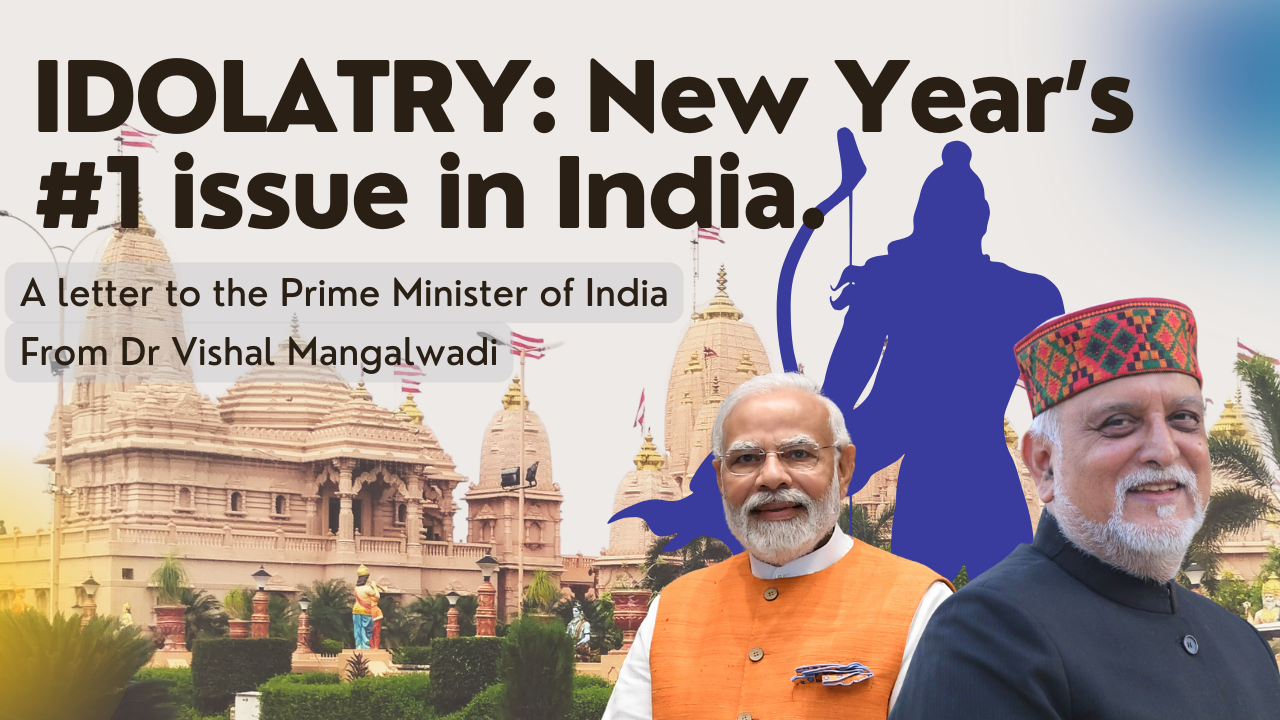
Idolatry: Letter to the Prime Minister of India

Monday, January 15, 2024 To,Hon’able Sri Narendra ModiPrime MinisterGovernment of IndiaNew Delhi, India Honorable Modiji, You have succeeded in making idol-worship India’s #1 political issue for January 2024. It is a milestone in Hindutva’s effort to make India a Hindu nation. Therefore, please allow me to explain why our founding fathers did not promote worship of mythical gods and goddesses. Instead, they adopted “Jan Gan Man” as our national anthem. It teaches us to pray to the sovereign Creator, the shaper of India’s destiny (Bharat Bhagya Vidhata). Our fathers accepted Pandit M. M. Malviya’s suggestion to make Satyameva Jayate (Truth Alone Triumphs) our national motto because they wanted Truth to replace myth as our authority. They agreed with reformers such as Mahatma Jyotiba Phule that Truth liberates, while myths are made to enslave. God is a Spirit. He has no physical shape or form. That’s why every effort to make an image of the invisible God, creates false gods. Worshipping man-made gods, creation, or creatures made by God or human imagination, weakened India. That is because we are created to seek Truth; to believe what is true. That is scientific temper. It is necessary to establish our dominion over creation. A culture that worships creation makes itself incapable of understanding and governing creation. Human culture flourishes when we seek God’s kingdom and do His will on earth. Myths may be good entertainment. They may impart some wisdom and societal values. However, allowing myth-makers to make our gods put us on a downward slide into deception’s abyss. Religion influences the way we live. When temples teach myths as the foundation of a culture, why shouldn’t businessmen use fake account books? Or, the police fabricate false cases to harass innocent citizens? Why should lawyers coach witnesses to tell the truth, the whole truth and nothing but the truth? Our courts — the temples of justice — are rapidly losing their credibility, because our culture of myth-making is turning them into centers of corruption. Whoever makes our gods has to create our ethics. This is the great dilemma, sir, that you are facing, as you prepare to inaugurate the Ram Temple in Ayodhya on January 22nd. The Shankaracharyas, the archbishops of the “Sanatan Dharma,” are telling you that since you are married, you cannot participate in Pran Prathishtha without your wife. As a young man, you followed god Rama when you abandoned her without divorcing. Is wife a husband’s property that can be abandoned or gambled away at will as did Rama and the Pandavas? Or, does she have a dignity that must be protected? If marriage is sacred, then is it not necessary to grant her a legitimate divorce? The Hindu Marriage Act of 1955 rejected the Ramayana’s myth-made ethics in order to restore to Hindu wives the dignity that God had bestowed upon them. Would your attempt to make India a Hindu Nation drive our women back into dark ages? Please allow me to mention one more consequence of Idolatry: Your attempt to inaugurate the new Ram Temple has run into troubled waters. Many Pundits, including the Shankaracharyas, are insisting that as a non-Brahmin you cannot be the Chief Guest at the Pran Prathishta ceremony. They are saying that you are abusing their religion for your political gain. You are violating, not promoting, the “Sanatan” Caste-system. According to them, Brahmin dharma gurus must have the seat of honor: you ought to sit at their feet. I commend your attempt to violate hierarchical caste system. Yet, the learned pundits are right. Making India a Hindu Nation requires reviving the Hindu social ethics of intrinsic inequity of castes. You cannot have your cake and eat it too. Is human equality a divinely revealed Truth? If so, shouldn’t new India make EQUALITY its cultural foundation? Or, must Hindutva drive India back into caste-based inequality? Should Sanatan culture weaken India by making the vast majority — the Bahujan — fourth and fifth class citizens? Sir, the Ram Mandir movement could deliver votes to you. But India will become a great nation only if it is built on Truth. Myth-makers want their will to be done in India: our Anthem prays that God’s will may be done in India: Thou art the ruler of the minds of all people, Dispenser of India’s destiny. Thy name rouses the hearts of Punjab, Sindhu, Gujarat and Maratha, Of the Dravida and Orissa and Bengal; It echoes in the hills of the Vindhyas and Himalayas, mingles in the music of Jamuna and Ganges and is chanted by the waves of the Indian Sea. They pray for thy blessings and sing thy praise. The saving of all people waits in thy hand, Thou dispenser of India’s destiny. Victory, victory, victory to thee. Respectfully Yours For Truth’s Triumph,Vishal Mangalwadi

Idolatry: Letter to the Prime Minister of India Read More »

Vishal Mangalwadi on THE BIBLE & INDIA’S RENAISSANCE

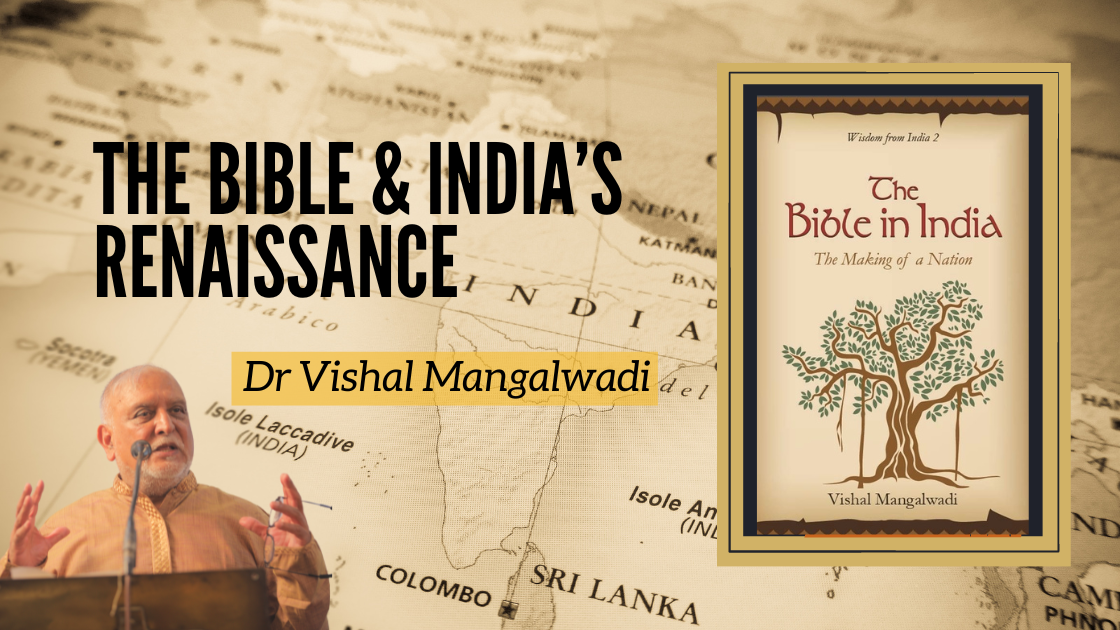
THE BIBLE & INDIA’S RENAISSANCE

LANGUAGE EMPOWERS PEOPLE India’s Renaissance began in Bengal in the early 19th century through a linguistic revolution. It was pioneered by a Baptist missionary, William Carey (1761-1834). This British cobbler-turned-linguist came to Bengal in 1793. At that time India had three classical languages: Persian, Arabic and Sanskrit. Indian elite had made our people powerless because they had turned them into languages of discrimination, to deprive the common man of the power of knowledge. The transformation of the people began by transforming their dialects into literary languages. That process empowered the people because it democratized knowledge, making it available to everyone. Average Brahmin scholars memorized Sanskrit Scriptures, not for thought but for performing religious rituals. They did not allow Sanskrit to become the mother-tongue of their own children, because they refused to teach it to their wives, let alone to non-Brahmins. Likewise, Muslim masses spoke local dialects while their religious leaders memorized the Quran in Arabic. Muslims ruled much of India for seven centuries, but they did not make Arabic the people’s language of learning, of impartation of facts and thought. Two centuries before Carey reached Bengal, Mughal Emperors had made Persian their court language. Their mother-tongue was Chagatai, not Persian. They ruled Bengal but took no interest in developing Bengali. Nor did they popularize Arabic and Sanskrit. Persian was a great language, but they made it their court-language, partly to make it difficult for Arabic knowing Muslims to learn state-secrets. In 1765, the Mughals gave the administrative authority or Diwani over Bengal to the East India Company. Yet, until 1800, the British merchants and rulers took no interest in Bengali dialects spoken by the people they governed. The only educational institution that the British Company established was Calcutta Madarasa (1780-’81). It was created to teach Arabic, Persian and Islamic Law. Arts and science, literature or humanities had no place in the curricula. Ten years later, in 1791, the British Company, not Hindu temples or ashrams, established the Banaras Sanskrit College in the state of Varanasi. Two centuries later, in 1974, the government of India upgraded it to become Sampurnanand Sanskrit University. This religious and political indifference to India’s intellectual progress began to change when British evangelicals responded to Charles Grant’s appeal to Christians to assume the moral responsibility for the development of the people of India. Grant’s Observations on “The Asiatic Subjects of Great Britain” (1792) inspired an Evangelical Member of Parliament, William Wilberforce, to campaign for India’s education. Grant and Wilberforce argued that it is immoral for Britain to send only merchants and mercenaries to India. Britain must also send educators. At that time, “secular education” did not exist anywhere in the world. In Europe, Education was a ministry of the Church because the Bible said that God “wants all men to be saved and come to the knowledge of the truth” (1 Timothy 2:4). The idea that every child needed to be educated was the practical application of the New Testament’s teaching that every child of God needed to serve his heavenly Father as a priest and manage God’s kingdom on earth as a prince or king. No one can do God’s will on earth if he/she does not know God. For this reason, everyone needed to study God’s word. That required translating the scriptures into every child’s mother tongue. This theological outlook had started the process of transforming European dialects into modern literary languages such as German, English, French. The campaign for India’s education, initiated by Charles Grant and led by Wilberforce was understood in the light of the Bible’s theology of Language and Education. Everyone understood that to send educators meant to send missionaries. Their mission will be to serve God and people — not money. Enriching people’s dialects to become literary languages will be one of the foundation stones of India’s awakening. Wilberforce began the campaign for South Asia’s education in 1793. Twenty years later, in 1813, British Parliament approved a new Charter of the East India Company. It required the Company to spend Rs.100,000 per year for the education of the people of India. How should this money be used? British rulers decided to use that money to establish a Sanskrit college in Calcutta. This triggered the Language Controversy which was resolved by the Macaulay-Minute of 1835. Macaulay favored English as the language that ought to enrich the vernacular, including Bengali. That had been suggested by Charles Grant in 1792. Raja Ram Mohan Roy became its champion in 1823. RAM MOHAN ROY’S OPPOSITION TO SANSKRIT Raja Ram Mohan Roy taught Sanskrit to William Carey while learning English from Carey. That interaction so changed him that he became a vocal opponent of the British plan to establish Calcutta Sanskrit College. On 11 December 1823, Roy wrote to the British Prime Minister, William Pitt, that the decision to teach “Sangscrit system of education would be best calculated to keep this country in darkness.” Perpetuating Sanskrit education will be contrary to the spirit of the great movement that had required the Company to invest money to educate India. Roy was a Brahmin and a Sanskrit scholar. He opposed the Company hiring Pandits to teach Sanskrit. The British policy, he wrote, ought to be to “promote a more liberal and enlightened system of instruction, embracing, mathematics, natural philosophy, chemistry and anatomy, with other useful sciences…” Roy knew that the Pundits’ monopoly of Sanskrit had stunted and enslaved the Indian mind. Language is the God given means to open and enhance the mind. He had grasped the Bible’s idea that Language is God’s gift to humanity. It binds God’s children into a community of ideas and values. Language makes us different from animals that are herded together by instinct, fear and force. Language allows us to improve our community by thinking critically in order to seek truth and wisdom. This is necessary to steward the creation. Language should not be what pundits have made it — a means of uncritical memorization of mantras. Why did pundits reduced language

THE BIBLE & INDIA’S RENAISSANCE Read More »

Vishal Mangalwadi on Conversion: India's election issue

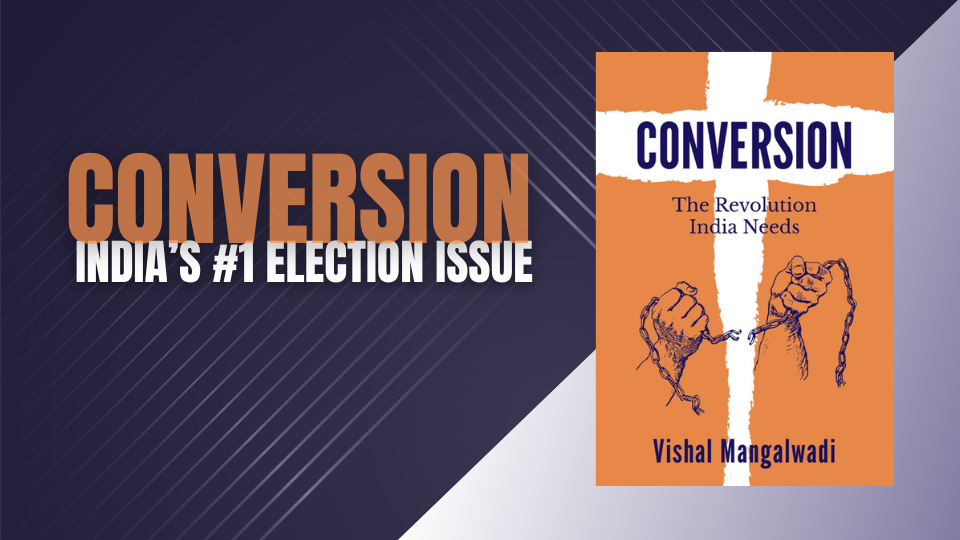
CONVERSION: India’s #1 Election Issue

On December 26, 2004, a 100-foot-high tsunami killed over 230,000 people, many of them in Chennai, Tamil Nadu. The tsunami was triggered by a 9.1-magnitude earthquake under the Indian Ocean. So many people died because, back then, India did not have an early warning system. Mighty tsunamis tend to travel under the water surface . . . until they hit the shore. On September 2, 2023, in Chennai, Mr. Udayanidhi Stalin, triggered a massive socio-religious-political earthquake. It has started a different tsunami. It will churn the electoral waters until the General Election’s results come out. Then its impact will be felt everywhere for a long time to come. Udayanidhi, a film-maker/actor turned Minister in Tamil Nadu, was delivering a carefully crafted written-speech at a ‘Sanatana Abolition Conference’ in Chennai. He, the son of the current Chief Minister M. K. Stalin and the grandson of a former Chief Minister, M. Karunanidhi, said, “Sanatan Dharma [i.e. Hinduism] is a principle that divides people in the name of caste and religion. Certain things like Malaria, Dengue and Corona need to be eradicated, not merely opposed. Likewise, Sanatana should also be eradicated.” How do you eradicate a religion? Dr. B. R. Ambedkar, the architect of modern India’s Constitution (1950), echoed the missionary’s view that CONVERSION, that is, acceptance of Truth is the only way to eradicate false and harmful beliefs. English speakers may not realize that “low”-caste Hindi YouTubers are ecstatic about Udayanidhi’s statement. He has become a voice of the voiceless. In the 1980s, my former boss Kanshiram, the founder of the BSP (Bahujan Samaj Party), popularized the (missionary-Phule-Ambedkar) idea that education, organization and politics were important for uplifting the lower castes. However, CONVERSION, Ambedkar said was the only remedy for Hinduism’s victims — the “low-castes”. BSP’s top leadership no longer advocates “conversion.” That has frustrated second-tier lower-caste leaders. BSP’s compromise with the BJP has allowed Udayanidhi to become their national spokesman. His timing is perfect: (a) During the previous month (August ’23), Uttar Pradesh’s Chief Minister went out of his way to woo Backward Caste youth. Hundreds of thousands of them walk for weeks to carry river Ganga’s “holy” waters on their shoulders. En route they infuriate ordinary citizens in many rude ways. Instead of guiding and controlling them, Yogi Adityanath showered on them flower petals from his helicopter and ordered the state machinery to honor their “religious” enthusiasm. Backward Caste leaders realized that the Yogi was recruiting OBC youth to his private militia. They will serve his Fascist interests and persecute Muslims and Christians. This forced thoughtful lower caste leaders and YouTubers to launch a counter offensive against a mean-spirited misuse of religious sentiment. Yogi’s blatant abuse of religion has compelled North India’s Backward Caste leaders to target his religion itself. Whenever a corrupt and brutal political dictator uses religion as his principle selling strategy, his opponents are left with little choice but to undermine his main weapon – religion. Muslims are learning this lesson in Iran as tens of thousands are quitting Islam. (b)  BJP’s political opponent will have to respond to its abuse of religion because it plans to use the new Ram Mandir in Ayodhya for its electoral gain. It can respond with “Soft Hinduism” but that is a failed option. ‘Oppose Hinduism’ is an alternative  strategy being advocated by Udayanidhi. The support for this is gathering momentum. growing . . . In public, politicians such as Rahul Gandhi will (rightly) counter BJP’s appeal to religion with economic issues such as poverty, unemployment, corruption and inflation. Mr. Udayanidhi’s offensive against Sanatan Dharma is, in part, an attempt to pre-empt the BJP’s effort to make an inroad in Tamil Nadu through emerging Hindu leaders such as Mr. K. Annamalai. It is also an attempt to cover up his party’s failures, inefficiencies and corruption. Nevertheless, a tsunami remains a tsunami, whether you like or dislike it. Here are a few important points to consider: 1. True conversion is NOT an outward change of religion. It is an inner spiritual transformation. It makes a rebellious sinner God’s loving, obedient child. 2. Nevertheless, Conversion has social aspects. In Iran it means quitting Islam. In India, it includes quitting Hinduism to join another religious or non-religious group. The Dravidian movement that invited Udayanidhi to speak on Abolishing the Sanatan religion, began as a rationalistic/atheistic effort with Periyar E. V. Ramasami. However, Udayanidhi’s family and party (DMK) rejected Periyar’s Atheism in favor of Theism. Buddhism does not appeal to a people looking for god – any god, other than a Hindu god. This makes Christianity the most available alternative in Tamil Nadu. 3. In North India, including in Maharashtra, Dr. Ambedkar made Neo-Buddhism a viable alternative to Hinduism, Islam and Christianity. However, the political dynamics of the previous seven decades have made Ambedkar’s Buddhism a religion, primarily of the Scheduled Castes (Dalits/SCs). That makes Buddhism unappealing to the OBCs (Other Backward Castes) who are presumed to be approximately 52% of India. 4. North India’s most explosive social reality is “intellectual” – change of paradigm. For a century or so, upper caste leaders such as Pandit Jawahar Lal Nehru and the lower caste opinion makers such as Ram Manohar Lohia looked at Indian society through Western academic lenses. They taught the OBC leaders such as Mulayam Singh and Lalu Yadav that the lower caste shudras were poor because of Capitalism. Current lower caste leaders no longer believe that paradigm. They understand that NOT Capitalism, but Hinduism made them “low” and “backward”. This makes Conversion necessary, along with discarding Nehru’s socialism and Modi’s Hindu capitalism. 5. How will Rahul Gandhi (or Arvind Kejriwal) respond to the tsunami triggered by Udhayanidhi? That, indeed, is an important question. Beginning with his great-grand father Nehru, grandmother Indira Gandhi, and father Rajiv Gandhi, Rahul’s party was controlled by the Brahmins. That is why the Congress ruled states enacted the first anti-conversion laws. That misguided “Soft Hinduism”  did not prevent conversions. It cost Congress Party the support of Muslims, Dalits and OBC because it began to be dismissed as Brahminism’s

CONVERSION: India’s #1 Election Issue Read More »

Vishal Mangalwadi on OPPENHEIMER, MODI & CAREY

OPPENHEIMER, MODI & CAREY

Can One Man Trigger a Chain-reaction That Destroys (or Builds) a Civilization? “Now I have become death, the destroyer of the worlds.” -Sri Krishna in the Bhagwat Gita A Review of Blockbuster Movie “Oppenheimer” Director: Christopher Nolan Oppenheimer: Played by Cillian Murphy Film script based on the 2005 biography “American Prometheus: The Triumph and Tragedy of J. Robert Oppenheimer” by Kai Bird Can one man, say, India’s Prime Minister Narender Modi, trigger a chain reaction that destroys “modern India” — a civilization still being built by William Carey’s successors? The question that haunted “the father of atom bomb,” theoretical physicist J. Robert Oppenheimer, was: Will his atom bomb start a chain reaction that destroys the world? Nuclear enemies, Pakistan and India, could turn Oppenheimer’s nightmare into reality. This month two Hollywood Blockbusters were released in India on the same weekend — Barbie and Oppenheimer. Barbie made ₹27.5 crore during the opening week, while Oppenheimer earned more than twice that amount, ₹73.15 crore! Oppenheimer beat Barbie because it made many Hindus proud that their Scriptures had a huge impact on a scientist of his stature. Robert Oppenheimer, the Director of the Manhattan Project, was reasonably certain that Adolf Hitler’s antisemitism will make it difficult for Nazi Germany to build the bomb. Back then, the Fascists saw Quantum Mechanics as “Jewish science.” As a communist leaning intellectual, Oppenheimer and his critics agreed that the American bomb will provoke Communist Soviet Union to make its own bomb. Oppenheimer dreaded that hatred between America and Soviet Union will turn the Cold War into Hot. Atom Bomb could become the power that destroys the world. The Bhagwat Gita helped Oppenheimer resolve his inner conflict. In a sex scene with his lover Jean Tatlock, played by Florence Pugh, Oppenheimer reads aloud one of the Gita’s shlokas. Vishnu’s incarnation Sri Krishna encourages reluctant champion-warrior, Arjuna, to forget ethical questions and do his caste’s duty to fight and kill. Why? Because God himself is Death and Destruction. After Nagasaki and Hiroshima were bombed, Oppenheimer told the media that the Bhagwat Gita was influence #2. The first influence that soothed his conscience was the collection of Baudelaire’s poems, “The Flowers of Evil” (Les Fleurs du Mal). In Baudelaire’s Foreword, Satan, identified as an Alchemist, says, “If rape, poison, dagger and fire, have still not embroidered their pleasant designs on the banal canvas of our pitiable destinies, it’s because our soul, alas, is not bold enough!” To build his diabolical weapon of mass destruction, Oppenheimer indeed needed great boldness, just as Arjuna needed a bold philosophy to direct his morally reluctant, oscillating soul. Oppenheimer’s Bomb did trigger a chain reaction. Not just Russia but many other nations have developed nuclear weapons and mind-boggling delivery systems. Some of the nuclear powers are led by souls without inner moral struggles. They are bolder than Oppenheimer. One example is Sri Narendra Modi, India’s militant Prime Minister who has cultivated an adversary – Islam – which is second to none in a capacity to hate and destroy. World War 2 started because militarily, Fascist Germany was stronger than its rivals. Yet, Germany paid a heavy price to learn that arrogance is neither virtue, nor safe. Modi’s Hindutva Brigade believes that it is powerful enough to crush Islam. Hindu-Muslim conflict appears to be a battle between an arrogant Goliath and a shepherd-boy, David. In such unequal conflicts, “Who is better-armed” is irrelevant. The relevant question is: who has the heart to strike first. Can a man trigger a chain-reaction that destroys a civilization? Sri Krishna says, YES … and Modiji is out to prove that he has the inner resolve to destroy modern pluralistic, tolerant India in order to build a Hindu Rashtra. The good news is that an individual can also trigger a movement that BUILDS a civilization. That is the history, Ruth and I have told in our book The Father of Modern India: William Carey. Carey began the movement that built modern South Asia. Now a diabolic spirit of hate is seeking to destroy it. (August 14 is Pakistan’s Independence Day; Aug 15 is India’s Independence Day; Aug 17 is William Carey’s birthdate) Please get your copy of “The Father of Modern India: William Carey” in the USA from manager@SoughtAfterMedia.com and in India from www.Triaze.com -Vishal & Ruth Mangalwadi

OPPENHEIMER, MODI & CAREY Read More »

Shopping Cart