Revelation Movement

Book Synopsis

MISSIONARY CONSPIRACY

MISSIONARY CONSPIRACY: LETTERS TO ARUN SHOURIE—A POSTMODERN HINDU  Preface to the First Edition Five major interests shaped the British East India Company’s rule in Bengal:  (i) Individual need and greed drove the rank and file of the Company. They had come to a distant land to make money. Their salaries were meagre because it was assumed—and permitted—that they would engage in private trade on the side. Military success made Clive almost a millionaire; other Company employees therefore saw nothing wrong in using the political power they had acquired in Bengal after 1757 to accept, if not extort, bribes. Their corruption, Lord Macaulay later remarked, made them “a gang of public robbers.” It turned British rule into “an empire of evil genii,” far worse than the Mughal Empire it had replaced. For the directors of the Company, India was simply (ii) a trading base. They had neither the interest nor the aptitude for military expeditions. Commercial rivalry from the French, Dutch, and Danish companies was challenge enough; they could not risk the very existence of their Company by turning it into a political rival of the Mughal Empire, Indian rulers, and other European powers. Their practical commercial outlook, for example, found Lord Wellesley’s empire-building military successes too costly for their ledgers—the reason he was eventually recalled. These traders understood that the best way to maximize profits was to minimize involvement in India. Consequently, they repeatedly insisted on closing Fort William College, their only college in India, where Company employees were trained for governance. The importance of political and military power for securing commercial interests was recognized early enough as indispensable in a land frequently at war with itself. Yet the idea of assuming a moral responsibility to reform or uplift India remained as absent from their thinking as it was from their account books. For British military leaders such as Clive and Wellesley, India became primarily (iii) territory to be conquered. Their chief concern was to weaken present and potential political rivals, not to empower Indians. They focused on combating forces that threatened British interests; the social and cultural evils that weakened and oppressed Indian society were not part of their agenda. This attitude explains why, although Lord Wellesley was convinced of the justice of Rev. Dr. William Carey’s campaign against Sati (widow-burning) in 1806, he did not prohibit the practice, as Lord Bentinck later did in 1829. For Wellesley, it was difficult enough to contend with Muslim and Hindu rulers; provoking Brahmanical opposition by interfering in socio-religious customs, however harmful, seemed politically unwise. A few widows being burned alive here and there affected neither British commercial interests nor imperial governance. For secular British scholars, India offered a fascinating new field of (iv) research—Indology—in which they had the privilege of being pioneers. Many Indologists admired ancient India and encouraged the emerging Indian intelligentsia to study, appreciate, and preserve its cultural heritage. The European rediscovery of ancient India eventually contributed to the growth of Indian nationalism. Yet Indians themselves could not readily access these scholarly works, since very few knew English beyond what was necessary for conducting business with the British. India had no printing press capable of disseminating such scholarship widely, nor did it possess colleges where Indological research could be systematically studied. Indeed, the preceding seven centuries of Islamic rule had not produced a single college in India, and no Hindu ashram had evolved into a university. The audience that read and appreciated the painstaking work of the Indologists was largely Western. Their scholarship, therefore, had little immediate impact on India itself. Several British humanitarians and philanthropists respected and even romanticized “the customs and wisdom of the natives.” These “Orientalists” patronized and promoted ancient Sanskrit literature, yet they had little trust in the Indians they encountered. As a result, British policy for many decades excluded Indians from positions of significant administrative responsibility. Some highly respected British officials, such as Sir Thomas Munro, agreed that dishonesty was widespread among Indians, yet opposed this discriminatory policy. They argued that if Indians were paid salaries comparable to those of the British, they too might develop higher standards of public integrity. Even so, these men generally dismissed the possibility that Indian society itself could be fundamentally reformed. Munro, Governor of Madras from 1820 to 1824, wrote in a letter dated 30 June 1821: I have no faith in the modern doctrines of the rapid improvement of the Hindoos, or of any other people. The character of the Hindoos is probably much the same as when Vasco da Gama first visited India, and it is not likely that it will be much better a century hence. When I read, as I sometimes do, of a measure by which a large province has been suddenly improved, or a race of semi-barbarians, civilised, almost of Quakerism, I throw away the book. The (v) reformers who advocated “the modern doctrine of the rapid improvement of the Hindoos” constituted the fifth force. They stood in opposition to the views of British scholars, the military and commercial interests of the Company, and the greed of individual Englishmen. At the turn of the nineteenth century, their influence within the Company was marginal. After 1813, however, their perspective gained ascendancy. It was strengthened and legitimised by the remarkable moral transformation that England had undergone during the second half of the eighteenth century as a result of the Evangelical revival led by John Wesley. This close-knit group of reformers believed that what God had done for a morally degenerate England, He could also do for India. Indeed, in keeping with their doctrine of Providence, they argued that God had entrusted India to England because He loved India and desired to bless her. Consequently, they believed it was England’s moral obligation to bless India by “evangelising,” “Christianising,” “civilising,” “educating,” and “modernising” her. To them, these terms were essentially interchangeable. To reshape British involvement in India according to their moral vision—that is, to empower, emancipate, and modernise India—this group of Evangelical Christians, led by
MISSIONARY CONSPIRACY Read More »

Vishal Mangalwadi on William Carey

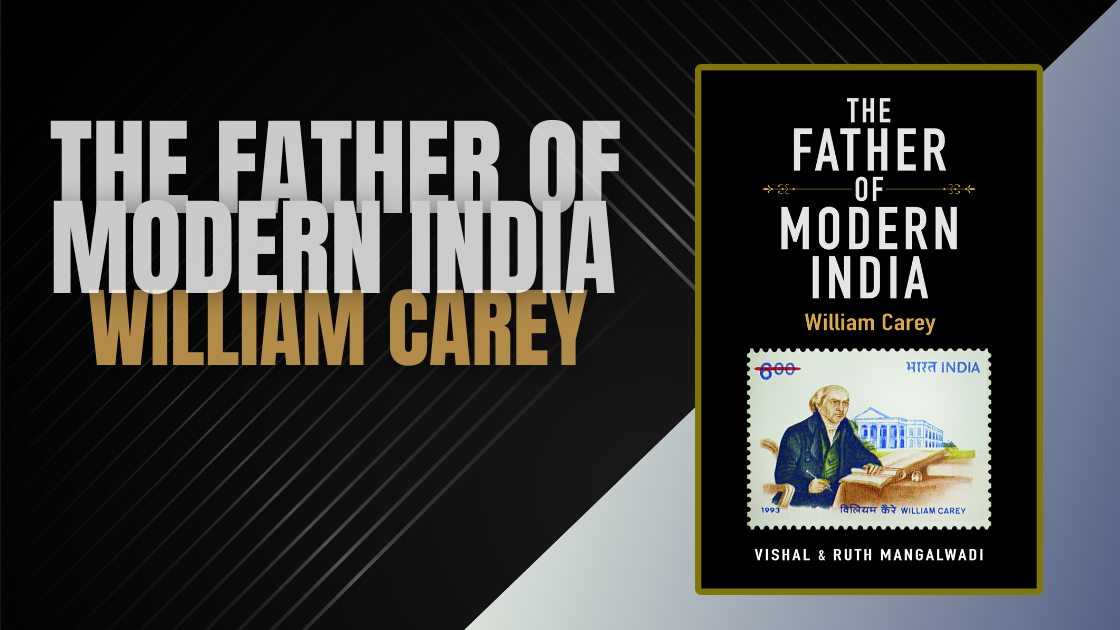
The Father of Modern India: WILLIAM CAREY

No nation called “India” or “Bharat” existed when William Carey landed in Bengal in 1793. The idea of “India” fascinated European explorers such as Christopher Columbus and Vasco da Gama because the Latin Bible said that “India” was Persia’s eastern-most province when Esther was the queen. That is, around 482 BC. Persians and Greeks pronounced river Sindhu (now in Pakistan), as “Hindu” or “Indu.” Persians named the area around Sindhu, “Hindustan”. They branded the religious practices of the natives as “Hindu.” Hindus had no name for Hinduism, since Tantra was the state-religion in most “Hindu” states. That is why, today, many Hindus prefer to brand themselves as “Sanatani”, which is a Buddhist term. Prior to the 19th century, each “people group” (extended family, caste, sub-caste, tribe or race) in India worshipped and feared its own deities and demons. They communicated in dialects that had no literature or Scripture. Aryans came to India with a fairly well-developed language, Sanskrit. But they did not develop a script for Sanskrit. They wanted Brahmin priests to memorize the “Sacred” sounds (Mantras). Writing down sacred mantras carried the risk of making public their secret source of power. The masses needed to be kept ignorant, so that they revere the priests’ access to gods. Famous Ashoka Pillars, for example, were carved between 268 to 232 BC. Yet, none of them had a single Sanskrit inscription. The priests’s wisdom was their monopoly, not to be shared with anyone, except devoted disciples. After William Carey, his contemporaries and followers began India’s intellectual renaissance… after European Indologists started translating Hindu scriptures, some Brahmins decided to adopt a pre-existing script, Devanagari, to write down Sanskrit scriptures. It should not surprise anyone that no Brahminical Scripture described India’s geography. For the Hindu worldview looked upon the external world as Maya — illusory, deceptive.  The Bible, in contrast, begins by describing Eden’s geography. Nobel Laureate, Rabindranath Tagore was the first Indian poet to describe pre-partition India’s geography as “Punjab, Sindh, Gujarat, Maratha, Dravid, Utkal, Banga, Vindhya, Himachal, Yamuna Ganga . . .” His song, “Jan, Gan, Man” (1911) was adopted as our national anthem, even though it excluded Jammu and Kashmir from his geography of “India”. Tagore’s geography of India came not from the Hindu tradition but from the Postal Act of 1899, enacted by the British Parliament. The Act left out Kashmir because the British had won it from a Sikh ruler and sold it to a Hindu. It was not a part of the India that the British ruled. In short, the Bible-informed Roman Catholic explorers brought to South Asia the geographic concept of India. William Carey’s paper “The Friend of India” popularized the idea of a geo-political nation-state called India. Carey and his colleagues in Calcutta’s Fort William College gave us the vision to build a great nation — just, educated, non-fatalistic and prosperous. For example, Carey, began transforming a moon-worshipping fatalistic culture of Astrology into a moon-studying culture of Astronomy that seeks to establish human dominion over nature and demons. William Carey became the father of modern India because he launched India into the trajectory of becoming a great nation. How did he do that? To build India as a modern nation, William Carey injected the Bible into our soul — in Indian languages, literature, education, worldview, law, civil services, family and governance. To give another example, it was the Bible that taught reformers such as Keshab Chandra Sen that a Hindu should have only one wife because God created only one Eve for Adam. Friends, we need your help to promote this book, including in all South Asian languages. All you need to do is to order copies: NOTE: This is a new, enlarged edition of our earlier book on Carey. This edition is being translated into Telugu, Tamil, Bengali, Malayalam and Hindi. Your support will help us start the translation also into Punjabi, Gujarati, Marathi and other South Asian languages

The Father of Modern India: WILLIAM CAREY Read More »

Vishal Mangalwadi's post about Buddha vs Aristotle vs Christ

WHY “B” WON OVER “A” BUT LOST TO “C” 

WHY “B” (the Buddha/Mysticism) WON OVER “A” (Aristotle/Logic) BUT LOST TO “C” (Church/Revelation) Dear Friends The following is the synopsis of Section II of my new book, “This Book Changed Everything: the Bible’s Amazing Impact On Our World.” In case you missed the synopsis of Section 1 (Chapters 1-3), you can find it on our website. Section II is titled “The West: Losing Its Soul“ Greek philosophers, Plato and Aristotle, rejected the idea that matter alone is real; soul, spirit, the non-material realm of goodness, beauty and truth are mere appearances. Their predecessors, Leucippus and Democritus had taught this “Materialism” in Greece. In ancient India, this philosophy was taught by Charvaka.  Most Greeks and Indians rejected philosophical materialism because it meant that you are nothing but a blob of meat. You survive by gobbling up other meat blobs that fly, swim, crawl or walk. Meat blobs such as mosquitoes and leeches love sucking your blood. Others (lions and sharks) would like to gobble you up. You have no intrinsic meaning, purpose, or value. This atheism implied that the material universe gives no reason why you shouldn’t champion aborting babies or enjoy cannibalism — eating other meat-blobs called “human beings.” There is no Creator, and He never  bestowed upon humans inalienable rights or dignity.  Of course, some people do “think” that eating a human being is a horrible evil. But what is “thought”? Are thoughts and words, grammar, logic, and ethics anything more than chemical reactions in a meat-blob? Can words have anything to do with truth? Didn’t accident turn animal sounds into language, to enable us to manipulate our environment? Plato felt that the observable phenomenon may be an appearance, a shadow, but shadows don’t make sense, unless they are images of a reality. There had to be a realm of eternal, non-material Forms, Ideas, or Truth. He called it a world of Logos (Word, Sense, Idea). The reality, soul and truth, had to be non-material, therefore, immortal.  Plato’s disciple Aristotle tried logic. However the Greek logic could not find the Logos (the Word) that they felt must be there. Therefore, Graeco-Roman world was ruled by myths, magic, and mysticism. Its experiments with truthless democracy and republicanism always ended in tyranny.  So, what created the modern world governed by logic and law, reason and ethics; affirming absolute morality, yet respecting individual rights; freedom of conscience, subjecting force to the authority of the spirit — to truth? Section II of “This Book Changed Everything: The Bible’s Amazing Impact On Our World” has four chapters: Chapter 4 is called, “Losing Soul, Logic, and Language”. It explains postmodernism: why Descartes, the Father of European Enlightenment, and his successors failed to prove that man exists as anything more than a blob of meaningless meat. Western immorality that resulted in Holocaust in Europe and genocide of pre-born babies in the USA is a consequence of Rationalism’s failure that began with Descartes and ended with Derrida. The chapter studies why Revelation made sense of human person, logic and language. Chapter 5 is called “Marginalizing the Center: The Church”. It explains the central role played by the Church’s Councils, Creeds, Catechisms, and Communities in civilizing Europe. Chapter 6, studies “Law and Liberty: Did Rome Put the Law above Caesars?” It revisits the West’s most important contribution to civilization — the rule of law. Beginning with the great Church Councils such as Chalcedon that set the stage for the Justinian Code, the chapter unpacks the Bible’s amazing contribution of liberty based on the rule of law. Chapter 7, “Bloodshed for Tolerance” looks at classical Europe’s intolerance and bloody “religious” wars of the Middle Ages in order to understand how the Bible succeeded in using African intellectuals such as Tertullian and Lactantius to institutionalize tolerance in Europe.  The Bible created the West, it reformed the West, and it can renew the post truth West again. A group of us are meeting in Phoenix, AZ from June 24-29, 2019 to begin an education revolution. Local churches will be equipped to partner with Christian universities and use web-based curricula. They will help grow the home-schooling movement into a church college movement. Please contribute $100 or more to support key non-American participants to travel to Phoenix. You will get a signed copy of the new book and a tax deductible receipt minus $25. Yours for the renewal of America’s soul, Vishal & Ruth Mangalwadi   PS. The following is the back-cover of the new book

WHY “B” WON OVER “A” BUT LOST TO “C”  Read More »

Shopping Cart