Revelation Movement

Books

WHY DID HINDUS SUPPORT COLONIAL RULE?

WHY DID HINDUS SUPPORT COLONIAL RULE? Arun Shourie & the Persecution of Christians To,Mr. Arun Shourie,Author, “Missionaries in India” & “Harvesting Our Souls.” Respected Mr. Shourie, You are fierce in your critique of your opponents, yet you remain a gentleman. I don’t think you hate the people you oppose. Yet, just as Savarkar’s hatred for Gandhi inspired his followers to assassinate the Mahatma, the hatred you have spread against missionaries resulted in burning alive Australian missionary, Graham Staines and his two sons. You spread the horrible idea that “converting” outcast lepers into human beings was an anti-national activity. The spirituality of hate that you fueled continues to poison India from Manipur to other Hindutva-ruled states. It drives Hindus to beat up pious women who pray for the sick. It forces the police and the courts to imprison pastors for asking people to repent for their sins. It has weaponized the judicial system to become the enemy of freedoms it is meant to uphold. One of your main attacks on missionaries was that some of them supported colonial rule. You ignored the fact that it was your alma mater’s chaplain, C. F. Andrews, a British missionary, who went to South Africa in 1913 to persuade Mahatma Gandhi to return to India. Right up to the end of his life, Andrews supported Gandhi’s struggle for India’s independence. My response to your criticism that missionaries supported colonial rule is a counterquestion: Why Did A Majority of Hindus Support Colonial Rule? Thirty-eight lakh (3.8 million) Indian soldiers fought on the frontlines to defend the British Raj. In WWI (1914-1919), around 70,000 of them laid down their lives; 87,000 more in WW2 (1939-45). When the first war began, Indian Maharajas (mostly Hindus) volunteered over 22,000 of their own soldiers to defend the British Empire that had colonized them. The Rajas gave their money, camels, horses and weapons to defend the British Empire. During the first war, thirty-one Indian princes pooled their resources to finance a hospital ship, Loyalty. They spent half-a-million (5 lakhs) British pounds for the ship to make forty voyages and carry about 15,500 sick and wounded soldiers who were fighting to defend Britain. Later in this letter I will discuss why a majority of Hindu soldiers, intelligentsia, merchants and Social Reformers supported the British Raj. Before that, let me remind you that the Maharajas did not defend the British Empire only from external attacks. In 1857, Hindu, Sikh and many Muslim rulers defended the Colonial rule from fellow Indians. Hindu Soldiers Supported Their Colonial Rulers The Bengal unit of the British-Indian army had good reasons to begin the revolt against the Raj. So did Hindu soldiers in the Madras and Bombay units have good reasons to remain loyal to the British. At least 25% of the Bengal unit also preferred the British Raj to the Rebels. The 1857 revolt was a great example of Hindu-Muslim unity. Almost 70% of the soldiers who won Delhi were Hindus. They compelled a Muslim to become the ruler of the whole of India. Colonial rulers won that war, in spite of exemplary Hindu-Muslim unity, because the majority of the Hindu Maharajas, most of the Sikh rulers and many Muslim nawabs supplied their own troops, weapons, transport, logistical assistance and strategic information to the British. Hindu Maharajas Defended the British Empire Maharaja Jayajirao Scindia of Gwalior, for example, opposed Rani Laxmibai of Jhansi and Tatya Tope of Kanpur. The British Raj won that great war because Maharaja Narinder Singh of Patiala, Raja Sarup Singh of Jind, Maharaja Bharpur Singh of Nabha, Raja Randhir Singh of Kapurthala, Maharaja Sardar Singh of Bikaner, Tukoji Rao Holkar II of Indore, Raja Balwant Singh of Ratlam were among the prominent Hindu rulers who actively supported Colonialism. Not just in Rajputana, but most Hindu rulers of Gujarat also supported Colonial rule: Khanderao Gaekwad, the Maharaja of Baroda State, is best remembered as actively pro-British. However, he was not the only one. Local Princely and Jagirdari Chiefs of Saurashtra & Rewakantha, rulers in smaller states such as Kathiawar, Lunawada, and Mahi Kantha remained loyal to the British Raj. Those who did not defend Colonialism proactively, chose neutrality. They refused to support the rebellion. Sikh Rulers Supported the British Raj Hindus rightly blame the Sikh rulers for defending the British Raj in 1857. The choice before them was a revival of the Mughal Empire or continuation of British Rule. They had good historical reasons for preferring the British. Prominent Sikh rulers who fought to defend British Colonialism were: Muslim Nawabs Also Preferred the British Empire Over the Mughal Not just Muslim rulers, but also prominent Muslim Intellectuals and Elites also defended the Raj. The most famous Muslim public figure was Sir Syed Ahmad Khan, who worked in East India Company’s judicial services. He actively saved European lives during the “mutiny” in Bijnor. Legendary poet Mirza Ghalib also cooperated with the British in Delhi.So, Why Did Hindu Rulers Support Colonialism? Rajputana, roughly present Rajasthan, had 20 major Hindu rulers. Not a single ‘Maharana Pratap’ rose up to fight against the British Raj. It has become fashionable to brand these Hindu supporters of colonial rule as “traitors.” That branding can be justified only if it is understood that the Hindu rajas were guilty of treason against a silly attempt to revive the Mughal Empire. They defended the Raj in their self-interest, exactly as self-interest inspired the rebels. Back then not a single leader had a vision for Independent “India.” Missionaries had to educate another generation before thoughtful Indians began to internalize the Bible’s idea of India as a sovereign nation. Cultivating the virtue of nationalism, putting nation above self and caste interests, was a long-term fruit of Christian education. No nation called Bharat or anything else had existed in anyone’s memory or history books. The myth that Bharat used to be a nation in the distant past is brand new. Besides 20 major kingdoms, Rajputana had nearly a hundred semi-autonomous “Thikanas” and “Jagirs.” Muslim invaders

WHY DID HINDUS SUPPORT COLONIAL RULE? Read More »

MISSIONARY CONSPIRACY

MISSIONARY CONSPIRACY: LETTERS TO ARUN SHOURIE—A POSTMODERN HINDU  Preface to the First Edition Five major interests shaped the British East India Company’s rule in Bengal:  (i) Individual need and greed drove the rank and file of the Company. They had come to a distant land to make money. Their salaries were meagre because it was assumed—and permitted—that they would engage in private trade on the side. Military success made Clive almost a millionaire; other Company employees therefore saw nothing wrong in using the political power they had acquired in Bengal after 1757 to accept, if not extort, bribes. Their corruption, Lord Macaulay later remarked, made them “a gang of public robbers.” It turned British rule into “an empire of evil genii,” far worse than the Mughal Empire it had replaced. For the directors of the Company, India was simply (ii) a trading base. They had neither the interest nor the aptitude for military expeditions. Commercial rivalry from the French, Dutch, and Danish companies was challenge enough; they could not risk the very existence of their Company by turning it into a political rival of the Mughal Empire, Indian rulers, and other European powers. Their practical commercial outlook, for example, found Lord Wellesley’s empire-building military successes too costly for their ledgers—the reason he was eventually recalled. These traders understood that the best way to maximize profits was to minimize involvement in India. Consequently, they repeatedly insisted on closing Fort William College, their only college in India, where Company employees were trained for governance. The importance of political and military power for securing commercial interests was recognized early enough as indispensable in a land frequently at war with itself. Yet the idea of assuming a moral responsibility to reform or uplift India remained as absent from their thinking as it was from their account books. For British military leaders such as Clive and Wellesley, India became primarily (iii) territory to be conquered. Their chief concern was to weaken present and potential political rivals, not to empower Indians. They focused on combating forces that threatened British interests; the social and cultural evils that weakened and oppressed Indian society were not part of their agenda. This attitude explains why, although Lord Wellesley was convinced of the justice of Rev. Dr. William Carey’s campaign against Sati (widow-burning) in 1806, he did not prohibit the practice, as Lord Bentinck later did in 1829. For Wellesley, it was difficult enough to contend with Muslim and Hindu rulers; provoking Brahmanical opposition by interfering in socio-religious customs, however harmful, seemed politically unwise. A few widows being burned alive here and there affected neither British commercial interests nor imperial governance. For secular British scholars, India offered a fascinating new field of (iv) research—Indology—in which they had the privilege of being pioneers. Many Indologists admired ancient India and encouraged the emerging Indian intelligentsia to study, appreciate, and preserve its cultural heritage. The European rediscovery of ancient India eventually contributed to the growth of Indian nationalism. Yet Indians themselves could not readily access these scholarly works, since very few knew English beyond what was necessary for conducting business with the British. India had no printing press capable of disseminating such scholarship widely, nor did it possess colleges where Indological research could be systematically studied. Indeed, the preceding seven centuries of Islamic rule had not produced a single college in India, and no Hindu ashram had evolved into a university. The audience that read and appreciated the painstaking work of the Indologists was largely Western. Their scholarship, therefore, had little immediate impact on India itself. Several British humanitarians and philanthropists respected and even romanticized “the customs and wisdom of the natives.” These “Orientalists” patronized and promoted ancient Sanskrit literature, yet they had little trust in the Indians they encountered. As a result, British policy for many decades excluded Indians from positions of significant administrative responsibility. Some highly respected British officials, such as Sir Thomas Munro, agreed that dishonesty was widespread among Indians, yet opposed this discriminatory policy. They argued that if Indians were paid salaries comparable to those of the British, they too might develop higher standards of public integrity. Even so, these men generally dismissed the possibility that Indian society itself could be fundamentally reformed. Munro, Governor of Madras from 1820 to 1824, wrote in a letter dated 30 June 1821: I have no faith in the modern doctrines of the rapid improvement of the Hindoos, or of any other people. The character of the Hindoos is probably much the same as when Vasco da Gama first visited India, and it is not likely that it will be much better a century hence. When I read, as I sometimes do, of a measure by which a large province has been suddenly improved, or a race of semi-barbarians, civilised, almost of Quakerism, I throw away the book. The (v) reformers who advocated “the modern doctrine of the rapid improvement of the Hindoos” constituted the fifth force. They stood in opposition to the views of British scholars, the military and commercial interests of the Company, and the greed of individual Englishmen. At the turn of the nineteenth century, their influence within the Company was marginal. After 1813, however, their perspective gained ascendancy. It was strengthened and legitimised by the remarkable moral transformation that England had undergone during the second half of the eighteenth century as a result of the Evangelical revival led by John Wesley. This close-knit group of reformers believed that what God had done for a morally degenerate England, He could also do for India. Indeed, in keeping with their doctrine of Providence, they argued that God had entrusted India to England because He loved India and desired to bless her. Consequently, they believed it was England’s moral obligation to bless India by “evangelising,” “Christianising,” “civilising,” “educating,” and “modernising” her. To them, these terms were essentially interchangeable. To reshape British involvement in India according to their moral vision—that is, to empower, emancipate, and modernise India—this group of Evangelical Christians, led by

MISSIONARY CONSPIRACY Read More »

Charlie Kirk recommends Vishal Mangalwadi's book

Reform the University to Honor Charlie Kirk

When the US president calls the media “Fake News,” he implies that the Post-Truth world’s best-educated and best-paid journalists are manipulators.  When he says that America’s Deep State is a “Swamp,” he suggests that Ivy League universities are breeding corruption. Charlie Kirk confronted universities because he knew that although K-12 education is essential, it is insufficient to reform the USA.  Charlie’s assassin seems to have grown up in a good home. It was the university that turned him into a murderer. Prof. Scott Masson of Tyndale University in Toronto summarizes the problem: “The problem that Charlie Kirk was confronting was the institutionalized wickedness of a demonically false view of language and human nature that has embedded itself in the university for at least a generation. According to the Left, words they dislike are violence (they don’t incite violence, they ARE violence), which is precisely what permits them (in their minds) to commit actual violence against their opponents. I saw Charlie Kirk as an ambassador to the radicalized university campuses.  And the ambassador has been assassinated. But the enemy is not flesh and blood (though the shooter needs to be caught and brought to justice), it’s the literary theories that preclude the possibility of the sort of dialogue Charlie Kirk was trying to foster, to no small degree of success. Charlie was a martyr to the truth, and he pointed directly to Jesus Christ, who is the way, the truth, and the life. I’m thankful for Charlie’s courageous life and witness.  May his death be the ‘turning point’ for many to follow in his Master’s footsteps.” Prof. Masson is right. In order to understand his analysis, you may need to read Gene Edward Veith’s study “Modern Fascism” (Concordia Press). . . Adolf Hitler did not build the Gas Chambers that burnt millions of innocent people. They were built and managed by university graduates—scientists, engineers, architects, chemists, doctors, administrators, police officers, military and judges! Decades before coming to power, Hitler was confident of Fascism’s victory because (he said) of the success of their theories in the universities.  Veith provides ample evidence that American universities have been teaching Fascism, defined as “Active resistance to transcendence.” There is no fear of God in post-truth universities because no God has commanded, “You shall not kill.” That means, there is no inalienable “Right to life” for a preborn child or a champion of civility. Charlie Kirk was right: America needs a reformation that will replace the university’s fascist worldview with God’s truth.  This morning, a pastor sent me the following text:  “Vishal,  My name is K. G. I pastor C. C. in B. M. (East Coast), I speak all over the country as well as pastoring the Flock at C. I have promoted your book, “The Book That Made Your World” more than any book other than SCRIPTURE over the last few years. There’s something I think you should know, that is, if you’re not already aware of it.  A few years ago I became friends with young Charlie Kirk. Aware of his perspective and his sharp intellect I gave him my first copy of your book. My copy of your book was all marked up by my pen. I had underlined so many things and wrote comments. I was SO excited by your work I had written much in the columns, but that was the only one I had when Charlie and I were together.  Charlie CONSUMED your book and assimilated immediately. I would continually hear it coming out of him once it entered his mind. For months after his first read he would say “The BIBLE created the soul of America!” The LORD used you to effect so many through that young man.” Watch Charlie Kirk recommend The Book That Made Your World: https://youtube.com/shorts/0h2Fci-3thM Since writing The Book That Made Your World, the Lord has raised up a team to build a global educational movement, which is developing TRUTHPEDIA. It is an online High school, university and Encyclopedia which will empower the global Church to create educational communities that provide an alternative to “demonically false views.” Truthpedia will ground wisdom, knowledge, understanding, information, and skills in the Spirit of Love, reintegrating Veritas (Truth) and Virtue (Character) in education. Please visit www.ThirdEducationRevolution.com and explore the TRUTHPEDIA proposal. Please pray and enable us to launch it in 2026. Yours for a re-formation of education Vishal & Ruth Mangalwadi

Reform the University to Honor Charlie Kirk Read More »

For a Renaissance of the Christian Mind

Watch a short video review of my book: https://youtube.com/shorts/_xGsxHISBJM?feature=shared Why did Christianity fail to win India?  It failed because the Western Church lost its universities to arrogant but barren Rationalism.  Oxford and Cambridge had been lost before William Carey founded the Serampore mission and University in the 1800s. In the USA, the Trinitarian Christianity lost Harvard in 1805. Many British civil servants and college chaplains who came to serve India, especially after 1813, came as Unitarians. They taught Theism but rejected Christ’s divinity and turned Indian thought leaders such as Raja Rammohan Roy and Tagore away from biblical Christianity. Not long after Western Christianity began educating India, it abandoned its own universities and retreated into theological seminaries. The seminaries put God’s light into an academic silo. As a result, Western Christianity lost interest in Truth and misinterpreted the Protestant Reformation as a movement that championed “Faith Alone.”  Evangelists misread 1 Timothy 2:4 as God “wants all men to be saved and go to heaven.” They ignored what Paul actually says: God “wants all men to be saved and come to the knowledge of the truth.” For that reason, Paul goes on to say in verse 7 that he was appointed an apostle—a teacher of truth to gentiles who believe in myth. In 1 Timothy 3:15, Paul goes further to teach that the Church was baptized with the Spirit of Truth not to tell stories but to be the “Pillar and Foundation of the truth.” The West became Post-Truth because the Church abandoned its universities. India is returning to her myths and idols because the evangelists preach “faith,” not truth. Faith enslaves. Truth liberates. That is why God wants us to believe what is true. Human beings can know the truth and bear witness to it because the God who knows has revealed truth. TRUTHPEDIA is one attempt to initiate a renaissance of the Christian mind. It will mobilize the global body of Christ to create an online Encyclopedia and university. Truthpedia will begin competing with modernist and postmodern rivals by giving away the world’s best K-12 curriculum for free. It will encourage every church to promote and support Educational co-ops for school and university-level education. It will work with the International Forum of Professors and Scholars to create an Encyclopedia dedicated to Veritas and Virtue. Watch a short video review of my book: https://youtube.com/shorts/_xGsxHISBJM?feature=shared Yours for a renaissance of the Christian Mind,Vishal & Ruth Mangalwadi 

For a Renaissance of the Christian Mind Read More »

Vishal Mangalwadi on Truthpedia - a new encyclopedia

HELP BUILD TRUTHPEDIA

The TRUTH baptized His body with the Spirit of Truth (John 14: 16; 15:26; 16: 12). Therefore, the Reformers risked their lives to bring Europe’s confused and compromised church back under the Truth’s authority. Builders of the modern world including John Amos Comenius (1592-1670), urged Christians to gather all knowledge in one encyclopedia. European Church could not do that because the Thirty-Years War (1618-48) had left Protestants and Roman Catholics too weak to take up that challenge. The French Enlightenment seized the opportunity and began misleading the modern age. The American Church had the ability to build a Wisdompedia during the 19th-20th centuries. Sadly, starting in 1805,  America’s Trinitarian Christianity began loosing its universities such as Harvard to Deism and Unitarianism. By the 1880s, at the height of its power, American evangelicalism began abandoning Truth and the universities, in favor of Anti-Intellectualism, Bible Institutes and a spirit of irrationality. Now, that Christianity’s centre of gravity is shifting southward to Africa, Asia and South America, it is time for the global body of Christ to come together to fill the earth with the Spirit of Wisdom as the waters cover the sea (Isaiah 11: 1-9). The Third Education Revolution has set up a pilot group to construct (a) Technology Platform needed for a new Truth-based Encyclopedia and (b) mobilize International Forum For Professors and Scholars (IFPS) to research all truth, gather it on one platform and disseminate it globally. You are cordially invited to contribute your thoughts on the subject on the Encyclopedia’s landing page: https://revelationmovement.com/truthpedia/ Vishal Mangalwadi

HELP BUILD TRUTHPEDIA Read More »

Vishal Mangalwadi on William Carey

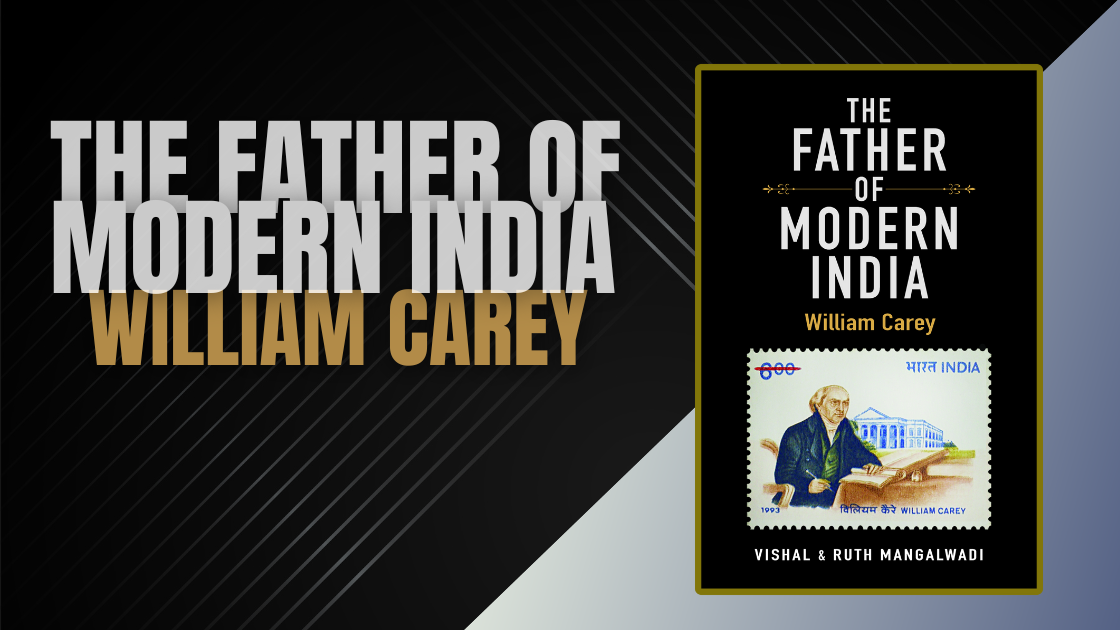
The Father of Modern India: WILLIAM CAREY

No nation called “India” or “Bharat” existed when William Carey landed in Bengal in 1793. The idea of “India” fascinated European explorers such as Christopher Columbus and Vasco da Gama because the Latin Bible said that “India” was Persia’s eastern-most province when Esther was the queen. That is, around 482 BC. Persians and Greeks pronounced river Sindhu (now in Pakistan), as “Hindu” or “Indu.” Persians named the area around Sindhu, “Hindustan”. They branded the religious practices of the natives as “Hindu.” Hindus had no name for Hinduism, since Tantra was the state-religion in most “Hindu” states. That is why, today, many Hindus prefer to brand themselves as “Sanatani”, which is a Buddhist term. Prior to the 19th century, each “people group” (extended family, caste, sub-caste, tribe or race) in India worshipped and feared its own deities and demons. They communicated in dialects that had no literature or Scripture. Aryans came to India with a fairly well-developed language, Sanskrit. But they did not develop a script for Sanskrit. They wanted Brahmin priests to memorize the “Sacred” sounds (Mantras). Writing down sacred mantras carried the risk of making public their secret source of power. The masses needed to be kept ignorant, so that they revere the priests’ access to gods. Famous Ashoka Pillars, for example, were carved between 268 to 232 BC. Yet, none of them had a single Sanskrit inscription. The priests’s wisdom was their monopoly, not to be shared with anyone, except devoted disciples. After William Carey, his contemporaries and followers began India’s intellectual renaissance… after European Indologists started translating Hindu scriptures, some Brahmins decided to adopt a pre-existing script, Devanagari, to write down Sanskrit scriptures. It should not surprise anyone that no Brahminical Scripture described India’s geography. For the Hindu worldview looked upon the external world as Maya — illusory, deceptive.  The Bible, in contrast, begins by describing Eden’s geography. Nobel Laureate, Rabindranath Tagore was the first Indian poet to describe pre-partition India’s geography as “Punjab, Sindh, Gujarat, Maratha, Dravid, Utkal, Banga, Vindhya, Himachal, Yamuna Ganga . . .” His song, “Jan, Gan, Man” (1911) was adopted as our national anthem, even though it excluded Jammu and Kashmir from his geography of “India”. Tagore’s geography of India came not from the Hindu tradition but from the Postal Act of 1899, enacted by the British Parliament. The Act left out Kashmir because the British had won it from a Sikh ruler and sold it to a Hindu. It was not a part of the India that the British ruled. In short, the Bible-informed Roman Catholic explorers brought to South Asia the geographic concept of India. William Carey’s paper “The Friend of India” popularized the idea of a geo-political nation-state called India. Carey and his colleagues in Calcutta’s Fort William College gave us the vision to build a great nation — just, educated, non-fatalistic and prosperous. For example, Carey, began transforming a moon-worshipping fatalistic culture of Astrology into a moon-studying culture of Astronomy that seeks to establish human dominion over nature and demons. William Carey became the father of modern India because he launched India into the trajectory of becoming a great nation. How did he do that? To build India as a modern nation, William Carey injected the Bible into our soul — in Indian languages, literature, education, worldview, law, civil services, family and governance. To give another example, it was the Bible that taught reformers such as Keshab Chandra Sen that a Hindu should have only one wife because God created only one Eve for Adam. Friends, we need your help to promote this book, including in all South Asian languages. All you need to do is to order copies: NOTE: This is a new, enlarged edition of our earlier book on Carey. This edition is being translated into Telugu, Tamil, Bengali, Malayalam and Hindi. Your support will help us start the translation also into Punjabi, Gujarati, Marathi and other South Asian languages

The Father of Modern India: WILLIAM CAREY Read More »

BRITAIN’S GREATEST GIFT TO INDIA — The Bible

Dear Friends,Ruth and I will be in British Parliament on October 23 to present to the Members of Parliament the case for the Bible as “The Book that Made Your World.” This is fitting since the Bible is the greatest gift that the British gave to India.It is also a wonderful way to celebrate the 500th anniversary of the Reformation that gave us Tyndale’s English New Testament and transformed medieval nations into modern Great Britain.Thanks to men such as William Carey, Henry Martin, and Claudius Buchanan, the Bible translators turned Indian vernaculars into literary languages. With that linguistic revolution came printing, publishing, press, literature, journalism, modern education, intellectual and social awakening.Majority of the Bible translations happened in Calcutta, after 1800, in the Fort William College. Three days a week Carey helped train civil servants in that college. The Bible became the book that transformed the corrupt administration of the British East India Company into the honest “steel frame” of clean governance.The Bible taught us that India should not be divided into petty, quarrelling kingdoms such as Israel and Judah; nor united under empires such as Mogul, Maratha, Sikh or British. God desired India to be a nation, a free nation, and a great nation, ruled not by sinful men, but by laws reflecting divine justice and righteousness.It was through the Bible that we learnt that God did not want us make up our own gods or worship creation — natural or demonic. He commands us to seek Truth and worship God in spirit and in truth.The Bible brought to India that idea of human equality that is unleashing the potential of every individual. It taught us that everyone — male and female — is created with the dignity of God’s likeness. The Bible revealed to us a secret of building great nations: strong families where a man has only one wife, and fathers his children like our Father in heaven.Thanks to hardworking, Bible-driven visionaries such as William Carey, Sam Higginbottom, and Norman Borlaug, India — a land of famines — is now a land flowing with milk and honey. It is the world’s largest producer of milk and exports food and fruit.Independent India acknowledged its profound intellectual, moral, social and political debt to Great Britain when it chose to govern itself not through Rajas and Maharajas, Sultans and Badshahs, but with Westminster style Parliament.Why did British Parliament became a model for our nation?Britain’s parliamentary governance did not come from Greek democratic states such as Athens. Greek city-state did not have parliaments. The British system developed because the Bible taught that God’s kingdom is managed by Elders (Revelation 4:4 etc.).Why do citizens elect Britain’s rulers? Great Britain adopted “Popular Sovereignty” as its model because Moses commanded the liberated slaves to choose their own leaders (Deuteronomy 1: 9-18). Why does the Prime Minister have greater power than the Monarch? India’s first Prime Minister, Pandit Jawaharlal Nehru, taught us Britain’s secret. He was India’s ‘First Servant’ he said, because that is what the title “Prime Minister” literally meant. This radical political idea began when the King of kings and the Lord of lords washed the feet of his disciples. He taught them that rulers lord it over their people in cultures that do not know God. He, the Messiah, had come to inaugurate a new kingdom in which rulers will become servants: For he came not to be served but to serve and to give his life for salvation of many.British Parliament became a model for India because Christian Members of Parliament, such as William Wilberforce, made it the conscience of the nation. When he became an MP, the Parliament was a gentlemen’s club. It served the interest of the club members. MPs resisted abolishing slave trade for two decades because they were the beneficiaries of that lucrative, reprehensible, trade.British Parliament became a model for many nations because the Bible transformed it. It will be my honor to reintroduce to some of the current MPs, “The Book That Made Your World.”This important assignment needs your prayers . . . and your help.The organizers would like to give a copy of the book to MPs along with the formal invitation.Thank you,Vishal MangalwadiWe need £3,500 for the books. Please consider donating.

BRITAIN’S GREATEST GIFT TO INDIA — The Bible Read More »

Shopping Cart